


What is Astigmatism?
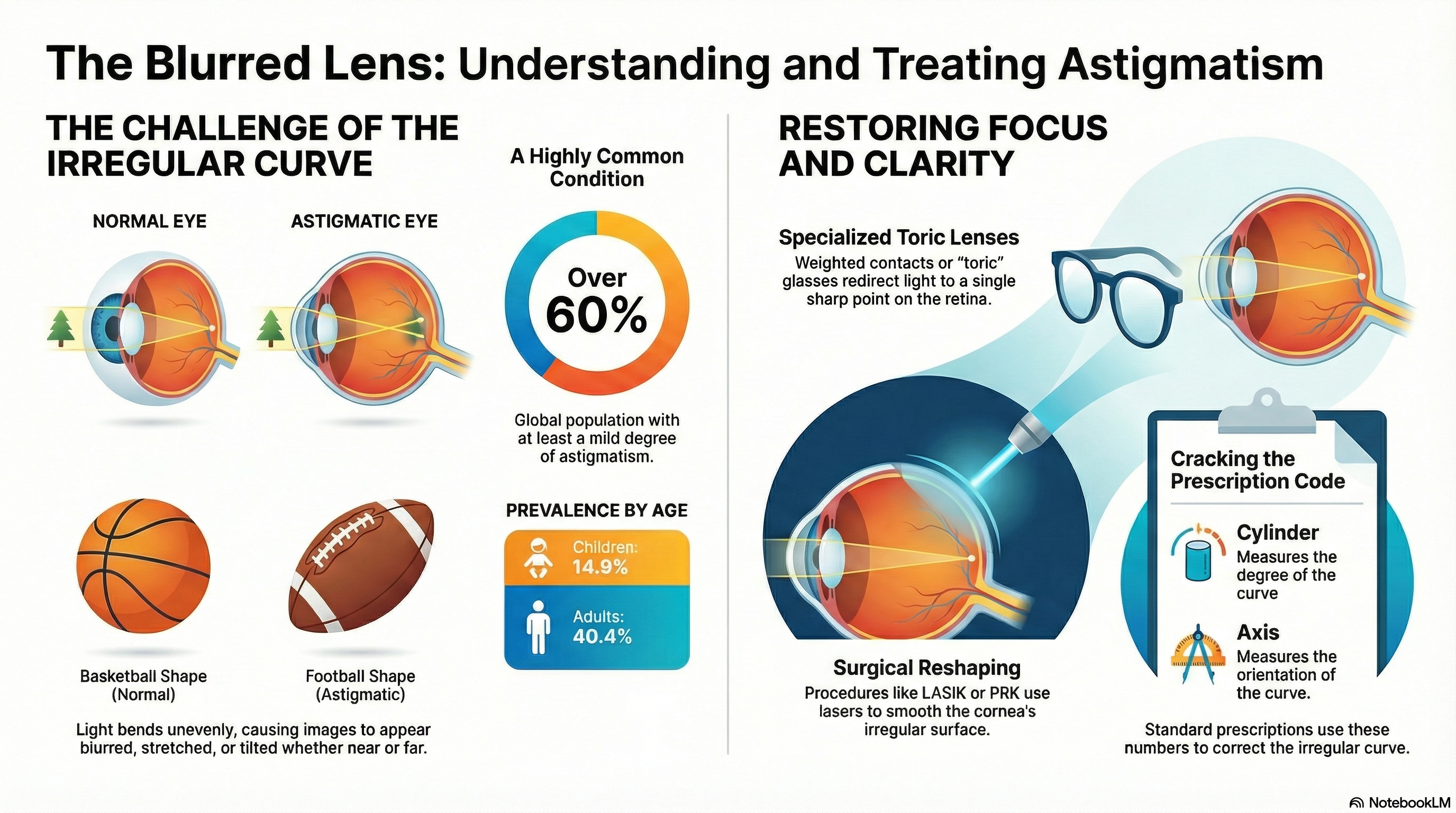
Astigmatism is a very common eye condition known as a "refractive error." In a perfectly shaped eye, the cornea (the clear front window) and the lens are curved evenly in all directions, like a basketball. This allows light to focus precisely on a single point on the retina at the back of the eye.
In an eye with astigmatism, the cornea or lens has an irregular curvature, shaped more like a football or the back of a spoon. Because the surface is not perfectly round, light is bent unevenly as it enters the eye. Instead of one sharp focal point, light is spread across multiple points, causing images to appear blurred, distorted, or "stretched" at all distances—both near and far.
Statistics show that over 60% of people have at least a mild degree of astigmatism, making it one of the most frequent vision concerns globally. It often coexists with other vision problems like nearsightedness (myopia) or farsightedness (hyperopia).
Causes of Astigmatism
Astigmatism is primarily a structural issue involving the shape of the eye. It is usually present at birth and can change slightly as you age.
Common Causes
-
Genetics: The most frequent cause. Most people inherit the specific shape of their cornea or lens from their parents.
-
Eye Development: As children grow, the shape of the eye can change, leading to the development or shifting of astigmatism.
-
Injury or Surgery: Scarring from an eye injury or changes following certain types of eye surgery (such as cataract surgery) can alter the corneal curve.
-
Keratoconus: A condition where the cornea progressively thins and bulges into a cone shape, causing severe "irregular" astigmatism.
Risk Factors and Demographics Research indicates that certain groups have a higher prevalence of the condition. For example:
-
Ethnicity: Studies show higher rates of astigmatism in East Asian and Hispanic populations. Among children, global prevalence is about 14.9%, while it rises to approximately 40.4% in adults.
-
Age: While young people often have "with-the-rule" astigmatism (steeper vertical curve), this frequently shifts to "against-the-rule" (steeper horizontal curve) as people age due to changes in eyelid tension and corneal structure.
Symptoms of Astigmatism
The symptoms of astigmatism can range from mild to severe, often leading to physical discomfort as the brain struggles to interpret blurred images.
-
Blurred or Distorted Vision: Objects may look fuzzy, or straight lines may appear tilted or wavy.
-
Eye Strain and Fatigue: Especially after long periods of reading, screen use, or detailed work.
-
Headaches: Persistent tension headaches caused by the constant effort to focus.
-
Night Vision Issues: Many people with astigmatism experience significant glare, halos around streetlights, and difficulty driving at night.
-
Squinting: An involuntary attempt to sharpen focus by narrowing the field of light entering the eye.
Diagnosis of Astigmatism
A comprehensive eye exam is necessary to diagnose astigmatism. Because it is a measurement of light-bending rather than a disease, doctors use several specialized tests to map the eye's surface.
Common Diagnostic Tests
-
Visual Acuity Test: Reading the Snellen chart (the chart with the "E" at the top) to determine how clearly you see at a distance.
-
Keratometry: A machine used to measure the curvature of the central cornea by reflecting light off its surface.
-
Autorefractor/Retinoscopy: These tools provide an objective measurement of how light is focused by your eye.
-
Corneal Topography: A sophisticated mapping technique that creates a 3D "contour map" of your cornea. This is essential for detecting irregular astigmatism or conditions like keratoconus.
Understanding Your Prescription An astigmatism prescription has three numbers. For example: -2.00 / -1.50 x 180.
-
Sphere (-2.00): Corrects nearsightedness or farsightedness.
-
Cylinder (-1.50): The amount of astigmatism correction needed.
-
Axis (180): The orientation (in degrees) of the irregular curve.
Treatment of Astigmatism
The goal of treatment is to redirect light so it focuses on a single point on the retina. There are several effective ways to achieve this.
Corrective Lenses
-
Eyeglasses: Special "toric" or cylindrical lenses are used to compensate for the eye's irregular shape. This is the most common and non-invasive treatment.
-
Contact Lenses: Soft toric lenses are weighted at the bottom to stay in a specific position on the eye. Rigid Gas Permeable (RGP) or "Scleral" lenses provide even sharper vision by creating a perfectly round new surface for light to hit.
Refractive Surgery For those who want to reduce or eliminate their need for glasses:
-
LASIK/PRK: Lasers are used to reshape the corneal tissue, smoothing out the irregular curves.
-
SMILE: A newer, minimally invasive procedure for certain types of astigmatism.
-
Toric IOLs: For patients undergoing cataract surgery, the surgeon can implant a Toric Intraocular Lens to correct astigmatism at the same time the cataract is removed.
Prevention of Astigmatism
Since astigmatism is primarily a result of the eye's physical shape—often determined by your DNA—it cannot be prevented in the traditional sense. However, you can prevent complications and worsening of the condition.
-
Avoid Eye Rubbing: Chronic, vigorous eye rubbing is a known risk factor for developing keratoconus, which causes severe and irregular astigmatism.
-
Early Screening for Children: Uncorrected astigmatism in children can lead to amblyopia (lazy eye), which may become permanent if not treated before age 8. About 13% of children with moderate astigmatism develop amblyopia.
-
Regular Eye Exams: Since the axis of astigmatism shifts as you age, regular check-ups ensure your prescription remains accurate, preventing chronic eye strain and headaches.
-
Eye Protection: Wearing safety goggles during sports or high-risk work can prevent corneal scarring and trauma-induced astigmatism.