







What is Cancer?
At its core, cancer is a disease of the genes. It arises from an accumulation of "hallmarks"—biological capabilities acquired during the multistep development of tumors. These include the ability to create a private blood supply (angiogenesis), the strength to ignore signals that tell a cell to die (apoptosis), and the capacity to evade the immune system.
Cancers are often named for the organs or tissues where they form. For example, carcinoma begins in the skin or tissues that line internal organs, while leukemia starts in the blood-forming tissue of the bone marrow. The most common cancers globally by incidence are:
-
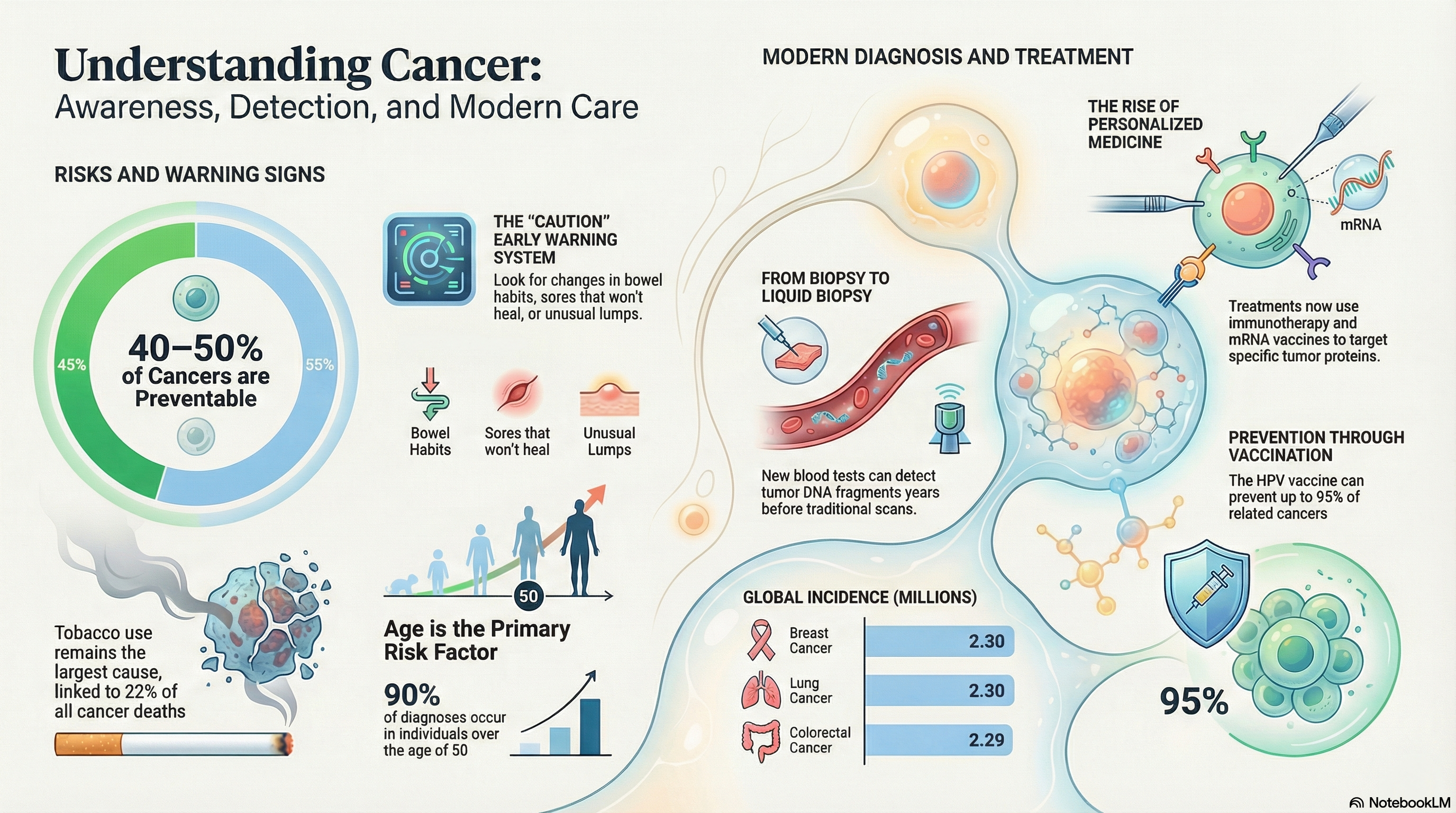
Breast Cancer: 2.30 million cases
-
Lung Cancer: 2.30 million cases
-
Colorectal Cancer: 2.29 million cases
-
Prostate Cancer: 1.41 million cases
-
Stomach Cancer: 1.26 million cases
Causes of Cancer
Cancer is caused by changes (mutations) to the DNA within cells. While some of these changes happen randomly, many are the result of external factors. Approximately 40–50% of cancers are considered preventable through lifestyle modifications.
Modifiable Risk Factors:
-
Tobacco Use: The largest preventable cause, linked to 22% of cancer deaths.
-
Diet and Obesity: High intake of red and processed meats and excess body fat are linked to 13 different types of cancer.
-
Infections: About 15–20% of cancers are triggered by infectious agents like HPV (cervical cancer), Hepatitis B/C (liver cancer), and H. pylori (stomach cancer).
-
Alcohol: Responsible for 5–6% of cases, affecting the liver, breast, and esophagus.
-
Radiation: This includes UV radiation from the sun and tanning beds, as well as radon gas in homes.
Non-Modifiable Risk Factors:
-
Age: 90% of cancers are diagnosed in individuals over the age of 50.
-
Genetics: Only 5–10% of cancers are strongly hereditary (e.g., BRCA1/2 mutations or Lynch syndrome).
Symptoms of Cancer
Because there are so many types of cancer, symptoms vary widely. However, the medical community uses the CAUTION mnemonic to help identify early warning signs:
-
Change in bowel or bladder habits.
-
A sore that does not heal.
-
Unusual bleeding or discharge.
-
Thickening or a lump in the breast or elsewhere.
-
Indigestion or difficulty swallowing.
-
Obvious change in a wart or mole.
-
Nagging cough or hoarseness.
Other general symptoms include unexplained weight loss (more than 10 lbs), persistent fatigue, and night sweats.
Diagnosis of Cancer
Early diagnosis is the most significant factor in survival. Modern medicine uses a "multimodal" approach to confirm the presence of cancer and determine its stage (how far it has spread).
-
Imaging: CT scans, MRIs, and PET scans help visualize tumors and their location.
-
Biopsy: This is the "gold standard." A small tissue sample is removed and examined under a microscope to confirm the cancer type and its molecular profile.
-
Liquid Biopsies (ctDNA): A newer 2026 breakthrough where a simple blood test can detect fragments of tumor DNA, often catching a recurrence months or years before a scan can see it.
-
Staging: Most cancers are staged from 0 to IV. Stage I is localized, while Stage IV means the cancer has spread to other parts of the body (metastatic).
Treatment of Cancer
Treatment has shifted from "one-size-fits-all" to Personalized Medicine, where therapies are chosen based on the specific genetic makeup of a patient's tumor.
-
Surgery: Often the first line of treatment to remove localized tumors.
-
Radiation and Chemotherapy: Traditional methods that use high-energy rays or powerful drugs to kill rapidly dividing cells.
-
Immunotherapy: A revolutionary class of drugs that trains your own immune system to recognize and destroy cancer cells.
-
Targeted Therapy: Drugs designed to attack specific molecules that cancer cells need to grow (e.g., KRAS inhibitors).
-
mRNA Vaccines: In 2025, personalized cancer vaccines entered the spotlight, helping to prevent the recurrence of cancers like melanoma and lung cancer by "teaching" the body to find specific tumor proteins.
Prevention of Cancer
While not all cancers can be prevented, you can significantly lower your risk by following these evidence-based guidelines:
Lifestyle Choices:
-
Quit Smoking: This is the single most impactful step you can take for your health.
-
Sun Protection: Use SPF 30+ and avoid tanning beds.
-
Limit Alcohol: No more than one drink a day for women and two for men.
Vaccination and Screening:
-
Get Vaccinated: The HPV vaccine can prevent 90–95% of HPV-related cancers, and the Hepatitis B vaccine protects the liver.
-
Routine Screening: Follow established guidelines for early detection:
-
Breast: Mammography starting at age 40–45.
-
Colorectal: Colonoscopy or stool-based tests starting at age 45.
-
Cervical: Pap and HPV testing starting at age 21.
-
Lung: Annual low-dose CT for those aged 50–80 with a significant smoking history.
-