


What is Cellulite?
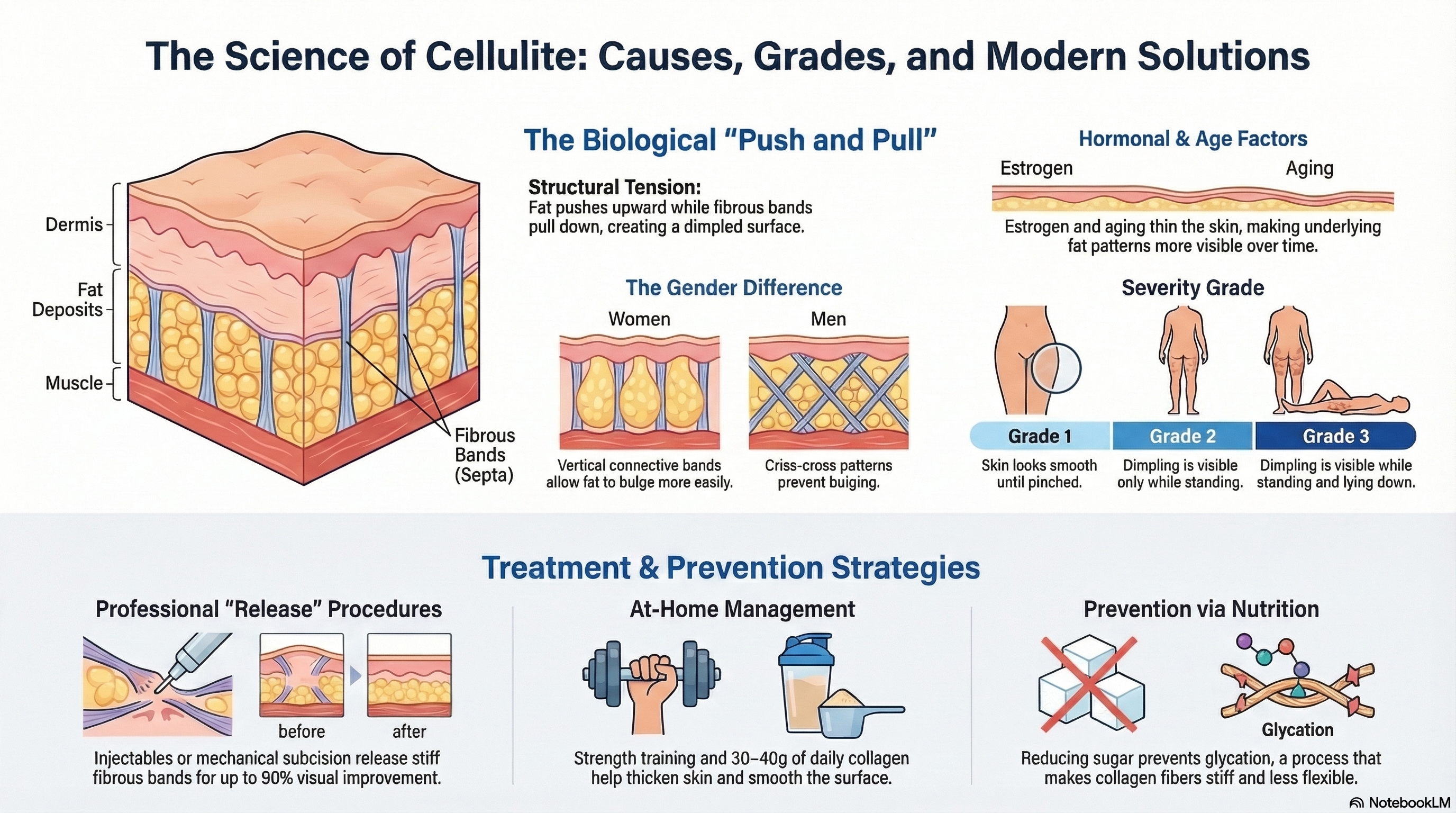
Cellulite occurs when the fat deposits beneath your skin push up through layers of connective tissue fibers called septa. These septae act like tethering bands that anchor the skin to the underlying muscle. When fat cells enlarge or the bands stiffen, the bands pull down on the skin while the fat pushes up, creating an uneven, puckered surface.
Doctors often use the Nürnberger-Müller scale to grade the severity:
-
Grade 1: Skin looks smooth while standing or lying, but dimpling appears if you pinch the skin.
-
Grade 2: Dimpling is visible while standing but disappears when you lie down.
-
Grade 3: Dimpling is clearly visible whether you are standing or lying down.
Causes of Cellulite
The development of cellulite is "multifactorial," meaning it results from a combination of several different biological elements.
-
Gender Dimorphism: Men rarely get cellulite because their connective tissue is arranged in a sturdy, criss-cross (net-like) pattern. Women have vertical, parallel connective tissue bands (like columns) that easily allow fat to bulge through.
-
Hormonal Influences: Estrogen plays a major role by stimulating fat storage in the hips and thighs and weakening connective tissue over time. This is why cellulite usually appears after puberty and can change during pregnancy or menopause.
-
Fibrous Septal Changes: Over time, the fibrous bands that tether the skin can become stiff or lose their elasticity, pulling more tightly and making dimples more pronounced.
-
Skin Thinning: As we age, the dermis (the thickest layer of skin) loses collagen and thins out, making the underlying fat and septae patterns more visible.
-
Genetic Predisposition: Your DNA largely determines your fat distribution, skin thickness, and the structure of your connective tissue.
Symptoms of Cellulite
The symptoms of cellulite are purely visual and tactile. It does not cause physical pain, though the affected areas may feel slightly different than surrounding skin.
-
Dimpling: The most common sign is a "pitted" or "bumpy" appearance, often compared to the texture of an orange peel.
-
Texture Changes: The skin may feel slightly less firm or "doughy" in areas with significant dimpling.
-
Location: It most frequently appears on the buttocks and the back of the thighs, though it can also be found on the lower abdomen, upper arms, and occasionally the breasts.
Diagnosis of Cellulite
Diagnosis is typically performed through a simple visual examination by a dermatologist or aesthetic professional.
-
Visual Assessment: A provider will look at the skin while you are standing and lying down to determine the grade of cellulite.
-
Pinch Test: By gently pinching the skin on the thigh or buttock, a provider can see if dimpling occurs, which helps identify early-stage (Grade 1) cellulite.
-
Ultrasound: In clinical research settings, ultrasound can be used to measure the thickness of the skin and the orientation of the fibrous bands, though this is rarely necessary for a standard diagnosis.
Treatment of Cellulite
While there is no permanent "cure," modern treatments in 2026 can improve the appearance of cellulite by 60% to 90%.
Top-Tier Professional Procedures
-
Injectables (e.g., Qwo): These involve enzyme injections that chemically dissolve the stiff fibrous bands pulling on the skin. Results can last 3 to 5 years.
-
Mechanical Subcision (e.g., Avéli): A physician uses a small device to manually "release" the tight fibrous bands under local anesthesia. This is often a single-session treatment.
-
Radiofrequency (RF) and Microneedling: Treatments like Morpheus8 or BodyTite use heat and needles to thicken the skin and shrink fat cells, making the surface look smoother.
At-Home Management
-
Strength Training: Building muscle in the glutes and hamstrings can help "push out" the skin, making dimples less noticeable.
-
Topical Creams: While they won't remove cellulite, creams containing retinol (to thicken skin) or caffeine and aminophylline (to temporarily shrink fat cells) can provide a 10–15% visual improvement.
-
Collagen Supplementation: Taking 30–40g of collagen peptides daily may help support skin elasticity and thickness.
Prevention of Cellulite
Because cellulite is largely genetic and structural, it cannot be entirely prevented, but its severity can be managed.
-
Maintain Skin Elasticity: Protect your skin from sun damage and avoid smoking, both of which break down collagen and make the skin thinner and more prone to dimpling.
-
Stable Weight: Avoid "yo-yo dieting" or rapid weight gain and loss cycles, which can overstretch the connective tissue and lead to more prominent cellulite.
-
Stay Active: Regular physical activity, particularly weight-bearing exercise, improves muscle tone and blood flow, which helps maintain the integrity of the skin's structure.
-
Dietary Choices: High-sugar diets can lead to "glycation," which makes collagen fibers stiff and less flexible. A balanced diet supports healthy connective tissue.