

What is Costochondritis?
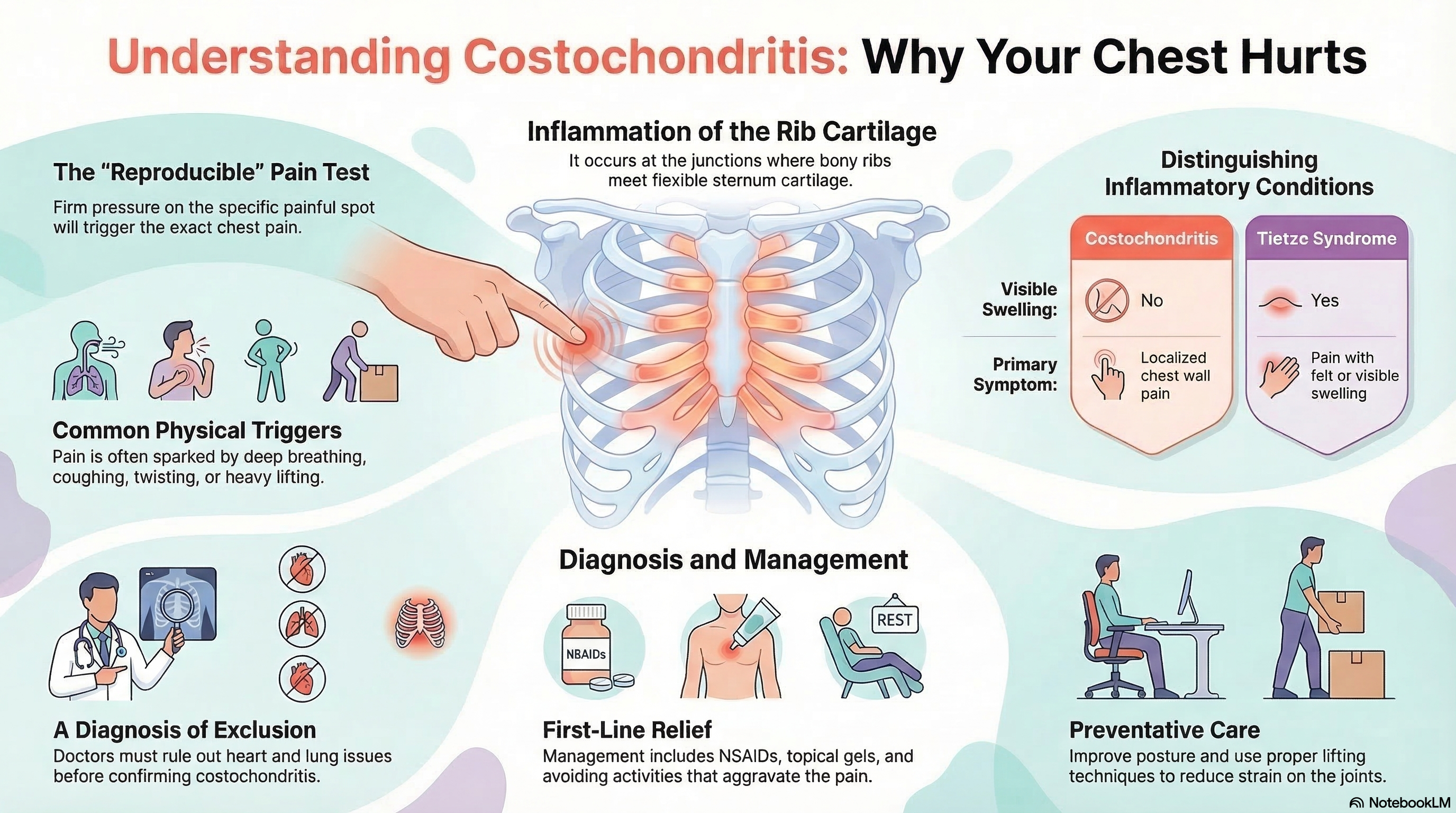
The "costochondral junctions" are the specific points where your bony ribs join the flexible cartilage that attaches them to the sternum. This flexibility allows your chest to expand when you breathe. When these junctions become inflamed, movements like deep breathing, coughing, or reaching can trigger intense pain.
Costochondritis is distinct from a similar condition called Tietze Syndrome. While both involve chest wall pain, Tietze Syndrome includes visible or felt swelling at the rib joints, whereas costochondritis involves pain without any outward swelling.
Causes of Costochondritis
In many cases, a specific cause is never identified. however, several common triggers have been recognized:
-
Physical Strain: Repetitive motions or sudden overexertion, such as heavy lifting, rowing, or starting an intense new workout (like push-ups or weightlifting), can strain the rib cartilage.
-
Injury or Trauma: A direct blow to the chest or a fall.
-
Respiratory Infections: Intense or prolonged coughing during a viral illness (such as a severe cold, bronchitis, or COVID-19) often triggers the inflammation.
-
Fibromyalgia: There is a strong association between the two; up to 50% of people with fibromyalgia may experience chronic costochondritis.
-
Underlying Arthritis: Less commonly, inflammatory types of arthritis like rheumatoid arthritis or ankylosing spondylitis can affect these joints.
-
Post-Surgical: It can occur following heart or lung surgeries where the breastbone was opened (sternotomy).
Symptoms of Costochondritis
The hallmark of costochondritis is localized chest wall pain that can be precisely pinpointed.
-
Location: Most often affects the 2nd through 5th ribs, usually on the left side of the breastbone.
-
Type of Pain: Sharp, stabbing, or aching. It may radiate to the back, abdomen, or shoulders, mimicking a cardiac event.
-
Triggers: The pain typically worsens with deep breaths, sneezing, coughing, or twisting the torso.
-
Reproducibility: A defining feature of costochondritis is that the pain is "reproducible." This means that if you or a doctor presses firmly on the specific spot where the rib meets the breastbone, it will trigger the exact pain you have been feeling.
Diagnosis of Costochondritis
There is no blood test, X-ray, or MRI that can "see" costochondritis. Instead, it is a diagnosis of exclusion, meaning your doctor will first rule out dangerous heart and lung conditions.
-
Physical Examination: This is the most important tool. Your doctor will perform maneuvers like the "crowing rooster" (lifting your arms while you extend your neck) to see if they can recreate the pain.
-
Cardiac Screening: Especially for patients over 35 or those with heart risk factors, doctors will perform an EKG and blood tests (cardiac enzymes) to ensure the heart is healthy.
-
Imaging: A chest X-ray may be ordered to rule out pneumonia or other lung issues. If these tests are normal and your chest wall is tender to the touch, a diagnosis of costochondritis is made.
Treatment of Costochondritis
Most cases resolve on their own within a few weeks with conservative management. Treatment focuses on reducing inflammation and managing pain.
-
Anti-Inflammatory Medications (NSAIDs): Oral medications like ibuprofen (Advil/Motrin) or naproxen (Aleve) are the first-line treatment. High doses may be needed for 1–3 weeks to fully calm the inflammation.
-
Topical Treatments: NSAID gels (like Diclofenac/Voltaren) or lidocaine patches can be applied directly over the painful area to provide relief without the stomach side effects of oral pills.
-
Physical Therapy: Stretching the chest muscles (pectorals) and improving posture can take the pressure off the rib cartilage.
-
Injections: For severe or "recalcitrant" cases that do not improve after several weeks, a corticosteroid injection directly into the inflamed joint can provide rapid, long-lasting relief.
-
Comfort Measures: Local application of heat and avoiding activities that aggravate the pain (like heavy lifting) are essential during the healing phase.
Prevention of Costochondritis
While you cannot always prevent an illness-related cough, you can take steps to reduce musculoskeletal strain on the chest wall.
-
Proper Lifting Technique: Avoid carrying heavy bags on only one shoulder and use your legs rather than your chest/back when lifting heavy objects.
-
Gradual Exercise Progression: When starting a new workout routine involving the upper body, increase the intensity slowly to allow the rib cartilage to adapt.
-
Posture Awareness: Correcting a "slumped" or forward-shoulder posture can reduce the constant tension on the costochondral joints.
-
Manage Underlying Conditions: If you have fibromyalgia or inflammatory arthritis, keeping those conditions well-managed can reduce the frequency of costochondritis "flare-ups."